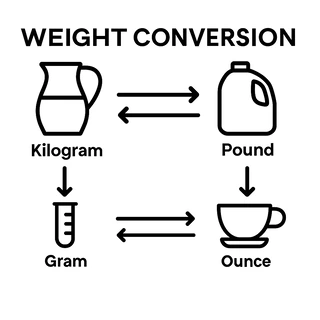
| Unit | Equivalent in Kilograms |
|---|---|
| Kilogram | 1.0000000000 |
| Gram | 0.0010000000 |
| Milligram | 0.0000010000 |
| Metric Ton | 1,000.0000000000 |
| Long Ton | 1,016.0469088000 |
| Short Ton | 907.1847400000 |
| Pound | 0.4535923700 |
| Ounce | 0.0283495231 |
| Carat | 0.0002000000 |
| Stone | 6.3502931800 |
| Microgram | 0.0000000010 |
| Nanogram | 0.0000000000 |
Weight and mass conversion is something almost everyone needs at some point. Whether you are cooking from an international recipe, buying gold, shipping parcels, doing gym math, or filling a lab form, a quick and reliable weight converter saves time and prevents mistakes. This page is a friendly, human explanation of how common weight conversions work, why they matter, and how to convert between units like kilograms, pounds, grams, ounces and even liters when density matters. We will also cover specialist topics such as converting mass to weight (force), gold weight conversions, and quick examples to help you understand each case.
Different countries and industries use different units. India and most of the world use kilograms and grams. The United States commonly uses pounds and ounces. Jewelers and precious metal traders often use grams and troy ounces. Because these systems all appear in everyday life, you frequently need a fast conversion. Searching for weight converter, weight converter kg to lbs or weight converter lbs to kg is common for cooks, travelers, merchants and fitness enthusiasts. A good converter gives accurate numbers instantly so you do not waste time or make costly errors.
Here are the most important, reliable conversion relationships used by almost every weight converter:
These constants are exact or standardized values used by calculators and conversion tables. A weight converter kg to lbs uses 2.20462 as the multiplier because it gives accurate and consistent results across all apps and spreadsheets.
Below are the simple formulas you or a calculator will use behind the scenes:
Kilograms to Pounds (kg → lb): lb = kg × 2.20462 Pounds to Kilograms (lb → kg): kg = lb × 0.453592 Grams to Kilograms (g → kg): kg = g ÷ 1000 Kilograms to Grams (kg → g): g = kg × 1000 Ounces to Grams (oz → g): g = oz × 28.3495 Troy Ounce to Grams (ozt → g): g = ozt × 31.1035
These are the core formulas used by any reliable weight converter calculator. If you need the values in a spreadsheet, you can copy these multipliers directly into Excel or Google Sheets and get exact results.
| Metric | Imperial / Other | Example |
| 1 kg | 2.20462 lb | 1 kg = 2.20462 pounds |
| 500 g | 1.10231 lb | Half kilogram = ~1.10 lb |
| 1 lb | 0.453592 kg | 1 pound = 0.453592 kilograms |
| 1 oz (ounce) | 28.3495 g | Useful for recipes and postage |
| 1 troy oz (gold) | 31.1035 g | Used for precious metals pricing |
Examples help make abstract numbers feel real. Below are typical conversions people search for and use every day. These will work for shopping, shipping, recipes, gym tracking and buying gold.
If you weigh 70 kilograms and want the value in pounds, multiply 70 by 2.20462. That gives 154.3234 pounds. Most people round to two decimal places and say 154.32 lb.
If your luggage allowance is 50 pounds and you want to know the kilogram value, multiply 50 by 0.453592. That equals 22.6796 kilograms, often shown as 22.68 kg.
A recipe calls for 200 grams of flour. To convert to ounces for a scale that uses ounces, divide 200 by 28.3495 which equals about 7.05 ounces. A kitchen-friendly converter gives the number so you can follow recipes accurately.
Gold is typically priced per troy ounce. If you have a small gold piece of 10 grams and want to know how many troy ounces that is, divide 10 by 31.1035 and get 0.3215 troy ounces. Traders use this conversion when comparing gram prices to international ounce prices.
Mass and weight are related but not identical. Mass measures the amount of matter in an object and is normally expressed in kilograms. Weight is a force, measured in newtons, and equals mass multiplied by gravity. On Earth the standard acceleration due to gravity is about 9.80665 m/s². That means if you want to convert a mass of 10 kilograms into the weight as a force, you multiply 10 × 9.80665 which equals 98.0665 newtons.
Weight (N) = Mass (kg) × Gravity (m/s²) Example: 10 kg ⇒ 10 × 9.80665 = 98.0665 N
Mass to weight conversion is useful in engineering and physics problems. A typical weight converter calculator focuses on mass units (kg, lb, g), but it is helpful to understand the physical difference when reading scientific documentation or preparing lab reports.
Sometimes you need to convert weight into volume, for example when measuring liquids or powders. A weight converter kg to liter is only valid if the density of the material is known. Water is the easiest example because its density at standard temperature is roughly 1 kilogram per liter. That means 1 kg of water equals 1 liter. But oil, honey, flour and sand all have different densities. A mass to volume converter uses the formula:
Volume (L) = Mass (kg) / Density (kg per L) Example: 1 kg of oil with density 0.92 kg/L ⇒ Volume = 1 / 0.92 ≈ 1.087 L
For solid goods like flour, density depends on packing and moisture. For industrial liquids, always use the precise density value for accurate kg to liters conversion.
Gold trading uses gram measures in India and troy ounces on global markets. There is also the traditional unit tola used in South Asia. Common conversions are:
If you want to convert 50 grams of gold into troy ounces, divide 50 by 31.1035 to get 1.6075 ozt. If a jeweler uses tola values, 50 grams equals about 4.285 tola. A gold weight converter helps investors and buyers quickly compare international gold rates.
Some online tools claim to convert photo height and weight or to estimate body measurements from a photo. It is important to be cautious. A photo alone cannot reliably convert to accurate weight without reference scale, camera distance and precise body proportions. If you need an estimate for clothing or modeling, use professionally calibrated tools or physical measurements. For health metrics, use a proper weight scale and height measuring tape. If you see a web tool labelled photo height weight converter, treat it as an approximation at best and avoid using it for medical, legal or official purposes.
Below are practical tables you can use to understand common conversions. They are ready to paste into a document or to use as quick reference. Each table is friendly and clear so people can glance and find values immediately.
| Kilograms (kg) | Pounds (lb) |
| 1 | 2.20462 |
| 5 | 11.0231 |
| 10 | 22.0462 |
| 25 | 55.1155 |
| 50 | 110.231 |
| 75 | 165.3465 |
| 100 | 220.462 |
| Grams (g) | Ounces (oz) |
| 50 | 1.7637 |
| 100 | 3.5274 |
| 200 | 7.0548 |
| 500 | 17.6370 |
| 1000 | 35.2740 |
If you like working in Excel or Google Sheets, here are formulas you can use. Put the numeric value in cell A1 and use the following formulas:
Kilograms to Pounds: =A1 * 2.20462 Pounds to Kilograms: =A1 * 0.453592 Grams to Ounces: =A1 / 28.3495 Troy Ounces to Grams: =A1 * 31.1035 Weight (Newtons) = Mass × g: =A1 * 9.80665
These formulas keep your spreadsheet accurate and reusable. Many people searching for weight converter calculator use these exact spreadsheet formulas to automate reports, invoices or lab logs.
Sometimes people ask about converting kg to cm or kg to liter. These are different concepts. Kilograms measure mass, centimeters measure length. There is no direct conversion between mass and length unless you assume a specific object with a known density and shape. Converting kg to liter is possible when density is known. For water the conversion is simple: 1 kg of water equals 1 liter. For other materials, always use the density-based formula introduced earlier.
Multiply the kilogram value by 2.20462. The result is the equivalent weight in pounds. Use a calculator or spreadsheet to avoid manual errors.
There are 1000 grams in one kilogram. Converting grams to kilograms is dividing by 1000.
Divide the number of grams by 31.1035 to get troy ounces. This is useful when comparing local gram rates to international ounce rates.
Only if you know the density of the material. Water is simple because 1 kilogram equals 1 liter at standard conditions. For anything else, use the mass divided by density formula to get volume.
Mass is the amount of matter measured in kilograms. Weight is the force caused by gravity and measured in newtons. On Earth we often speak loosely and use kilograms to mean weight, but scientifically they are different.
Yes. Precious metals use troy ounces which are slightly heavier than common avoirdupois ounces. 1 troy ounce is 31.1035 grams, while 1 avoirdupois ounce is 28.3495 grams.
Photo height weight converter tools claim to estimate body weight from images, but they are not reliable for health or medical use. A photo cannot substitute for