
Speed Converter: The Ultimate Guide to Global Velocity Units
Speed is one of the most fundamental measurements in physics, transportation, and daily life. Whether you are checking the speed limit in a foreign country, analyzing a sports performance, or conducting a scientific experiment, a reliable speed converter is indispensable. Because different regions and industries use different measurement systems—like km/h to mph in automotive sectors or knots in aviation—having an online speed converter ensures accuracy and safety.
Our speed converter online is built to handle complex calculations across all major units including Kilometers per Hour (km/h), Miles per Hour (mph), Meters per Second (m/s), and even advanced aeronautical units like Mach.
Why Do We Have So Many Speed Units?
The variety of speed units exists because of historical developments and specific industrial needs. For example:
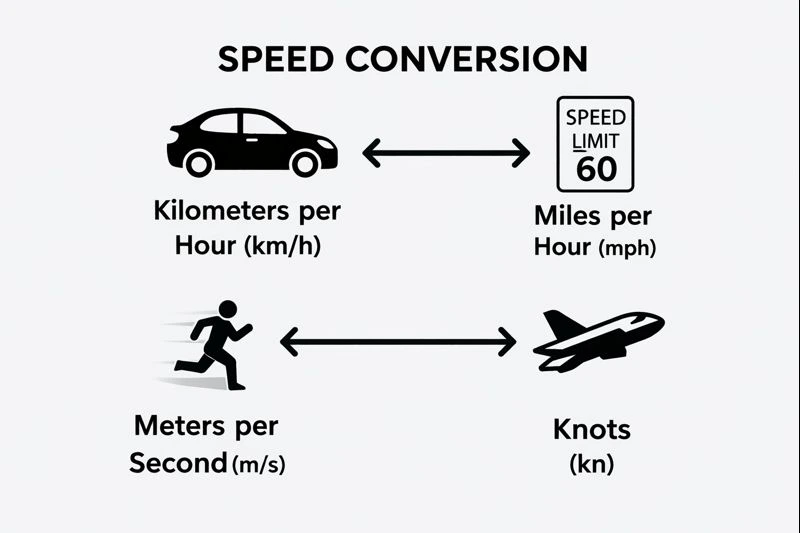
- Kilometers per Hour (km/h): The global standard used by the majority of the world for daily road traffic.
- Miles per Hour (mph): Primarily used in the USA, UK, and some island nations for highway regulations.
- Meters per Second (m/s): The official SI unit used in physics, science, and engineering to calculate motion.
- Knots (nautical miles per hour): The essential unit for maritime and aviation navigation based on the Earth’s circumference.
- Mach: A specialized unit that compares an object's speed to the speed of sound.
How to Convert Speed Manually: The Formula Engine
Every professional speed converter calculator relies on fixed mathematical factors to bridge these units. If you want to understand the logic behind the tool, here are the core multipliers used by our system:
• Miles per Hour to Kilometers per Hour (mph → km/h): Multiply by 1.60934
• Meters per Second to Kilometers per Hour (m/s → km/h): Multiply by 3.6
• Knots to Miles per Hour (kts → mph): Multiply by 1.15078
• Mach to Miles per Hour (Mach → mph): Multiply by 767.269
Who Benefits from Our Speed Converter?
This tool is designed for a broad spectrum of users, each with unique conversion requirements:
- International Travelers: If you are driving a rental car in a country with different road signs, you might need to convert km to mph instantly to avoid speeding tickets.
- Students and Educators: Science students frequently use our pace to speed converter logic to translate laboratory data into standard units for their reports.
- Athletes and Coaches: Runners often convert their m/s sprinting speed into km/h to compare their performance with professional athletes.
- Pilots and Sailors: Even with advanced cockpit computers, pilots use a speed converter online for quick manual cross-checks between knots and ground speed.
Speed Unit Comparison Table
Below is a quick reference table showing common speeds across various units to help you visualize the differences.
| km/h | mph | m/s | knots |
|---|---|---|---|
| 10 | 6.21 | 2.78 | 5.40 |
| 50 | 31.07 | 13.89 | 27.00 |
| 100 | 62.14 | 27.78 | 54.00 |
| 120 | 74.56 | 33.33 | 64.79 |
Expert Insights: Conversational FAQs
What is the most accurate speed unit?
Accuracy depends on the context! For scientists, m/s is the most accurate for energy calculations. For marine navigation, knots provide the best spatial accuracy due to their link to nautical miles.
How do I convert "Mach" to MPH?
Mach represents the speed of sound. At sea level and standard temperature, 1 Mach equals roughly 767 mph. If you are tracking a jet, simply use our speed converter and select "Mach" as your input unit.
Can I use this as a pace converter for running?
Absolutely. If you know how many kilometers you cover in a specific time, you can find your speed in km/h and then convert it to mph to compare with treadmill settings.
Why is there a difference between MPH and KPH?
It comes down to regional systems. The Metric system (KPH) is used by 95% of the world, while the Imperial system (MPH) is still the law in the United States and the United Kingdom.
Is this tool safe for professional use?
Yes. SmartCalcZone uses high-precision conversion factors derived from international standards, making it suitable for academic, professional, and personal use.
Conclusion
Understanding speed in different units shouldn't be a struggle. Whether you're a curious traveler, a dedicated student, or a professional pilot, our speed converter online is designed to provide you with the fastest and most accurate results possible. Bookmark this page for all your future velocity conversion needs!